Rideshare services are a common way to get around Midwest City, particularly for workers commuting to Tinker Air Force Base, residents navigating the I-40 corridor, and people heading to the commercial areas along SE 29th Street. When an Uber or Lyft driver causes a crash in these areas, the path to compensation is more complicated than a standard standard auto-collision claim in Midwest City. Rideshare companies structure their insurance coverage in layers that depend on exactly what the driver was doing at the moment of impact. If you were injured in a Midwest City Uber or Lyft accident, speaking with an attorney early can help you avoid the coverage gaps that many people discover only after receiving a denial from an insurer.

How rideshare insurance works in Midwest City
Uber and Lyft classify their drivers as independent contractors, not employees. That distinction shapes how insurance responds after a crash. Because drivers are not employees, the companies limit when their coverage applies. Both Uber and Lyft divide coverage into three phases based on the driver’s app status at the moment of the collision.
- Phase 1 (App off): The driver’s personal auto insurance is the only coverage available. Uber and Lyft provide no coverage whatsoever.
- Phase 2 (App on, waiting for a ride request): Uber and Lyft provide limited contingent liability coverage: up to $50,000 per person injured, $100,000 per accident in total, and $25,000 for property damage. This contingent coverage only activates if the driver’s personal insurer denies the claim outright.
- Phase 3 (Matched with a rider or ride in progress): Uber and Lyft provide $1 million in third-party liability coverage, plus uninsured and underinsured motorist coverage and contingent comprehensive/collision coverage.
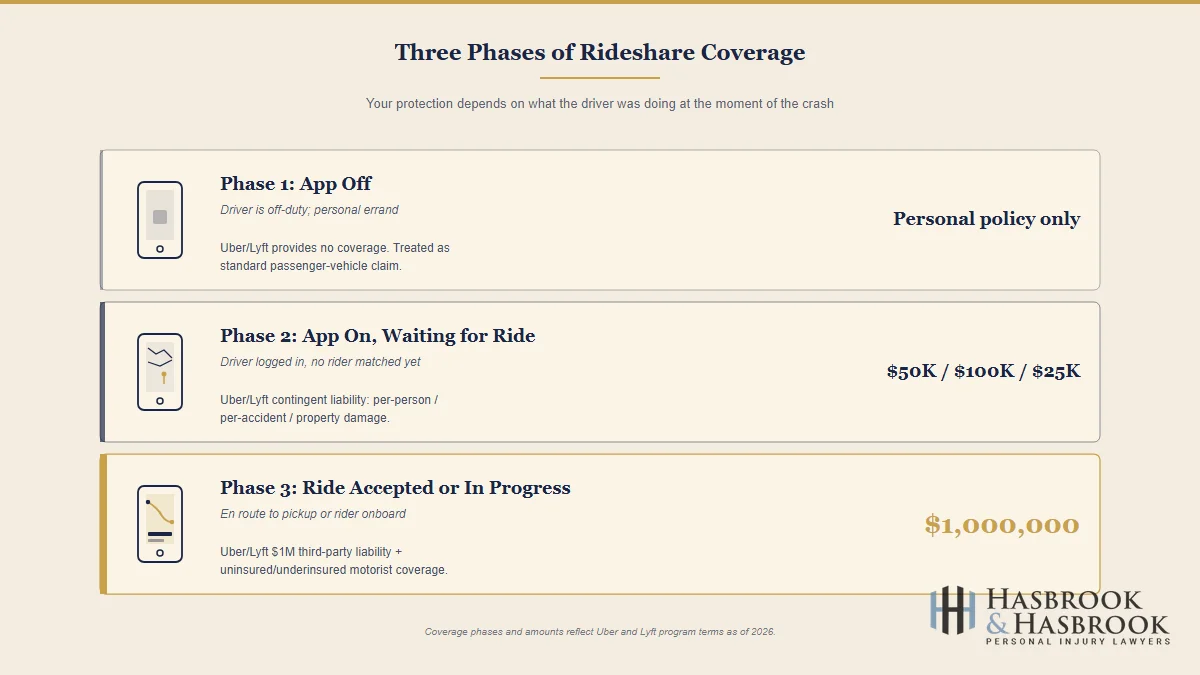
The coverage gap most often surfaces in Phase 2. If an Uber driver had the app open but had not yet accepted a trip request, the $1 million policy does not apply. A driver who has not added a rideshare endorsement to their personal auto policy may have significant shortfalls in coverage, because many standard personal auto policies exclude rideshare activity entirely. Insurance adjusters determine which phase applies by reviewing the driver’s GPS records and app status logs from the moment of the crash, which is why preserving this information promptly matters.
For a detailed comparison of why rideshare claims differ from ordinary collision claims, see the parent page covering Oklahoma City Uber accident claims.
Common causes of Uber and Lyft accidents in Midwest City
Rideshare drivers face a distinct set of pressures that contribute to accidents. Understanding which factor caused your crash shapes the liability analysis and determines which parties may bear responsibility for your injuries.
- Distracted driving from app use: Drivers must interact with the Uber or Lyft app to accept rides, navigate, and complete trips. This creates a built-in distraction that sets rideshare crashes apart from standard phone-distracted driver collisions in Midwest City. Evidence of app activity at the time of impact can prove the driver was interacting with a phone while moving.
- Speeding to maximize earnings: Per-trip compensation and surge pricing create financial pressure to complete as many rides as possible. This incentive structure contributes to excessive-speed collisions and aggressive driving, particularly on high-traffic stretches of I-40 through Midwest City.
- Driver fatigue: Many rideshare drivers combine platform driving with other employment and work extended shifts. Fatigue impairs reaction time and judgment in ways that parallel impairment from alcohol.
- Inadequate background screening: Uber and Lyft conduct background checks, but their screening processes have gaps. Drivers with prior traffic violations may still qualify, and periodic rescreening is not standard practice, so violations that occur after initial approval are not always caught.
- Impaired driving: Drivers who are impaired by alcohol or under the influence of drugs create the same danger as any impaired driver, with the additional complexity that the rideshare company may dispute responsibility for the driver’s conduct.
- Poor vehicle maintenance: Rideshare vehicles accumulate high mileage quickly, and maintenance responsibility rests with the driver. Brake failure or tire blowouts caused by deferred maintenance can establish driver negligence, and in some cases a manufacturer defect may add a products liability angle.
Injuries common in Midwest City rideshare crashes
Rear-seat passengers in rideshare vehicles often experience a different injury profile than front-seat occupants. The absence of proximity to the steering wheel can reduce certain injury risks, but rear passengers have fewer restraint options and may experience more rotation-based injuries in side-impact collisions.
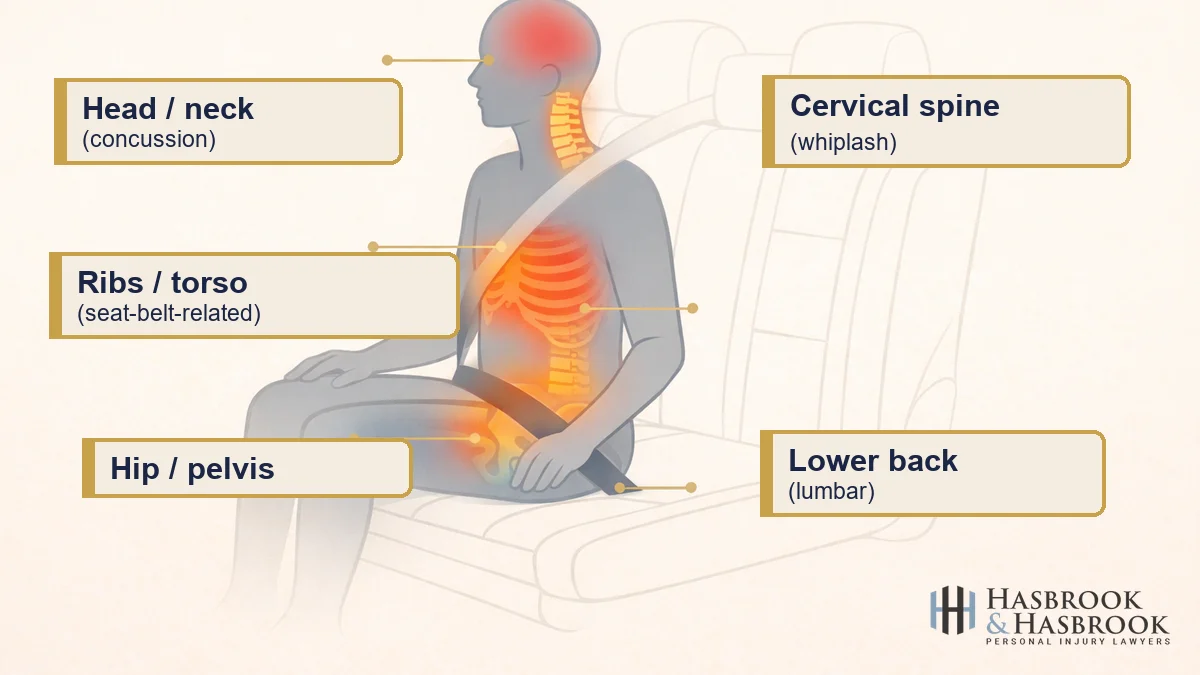
- Whiplash and soft-tissue injuries: Cervical strain from acceleration-deceleration forces is the most common injury in rear-impact crashes and frequently affects rideshare passengers who are not braced for impact. Symptoms may not appear until 24 to 72 hours after the collision, which is why same-day medical evaluation matters even when you feel uninjured.
- Traumatic brain injuries: Head impacts against vehicle interiors can produce concussion and brain-trauma injuries ranging from mild to severe. These injuries require specialized neurological evaluation and carry long-term consequences for work capacity. See our guide on the typical settlement range for a TBI claim.
- Spinal cord injuries: High-speed and side-impact crashes can cause cord-level neurological damage with permanent consequences including partial or full paralysis. These cases involve the highest lifetime care costs and typically require expert medical testimony to establish the full scope of future damages.
- Broken bones: Fractures are common across all crash types, particularly in the arms, wrists, and ribs as passengers brace for impact. Our fracture-injury practice page covers the damages framework for these claims.
- Fatal injuries: When a rideshare crash kills a passenger or another driver, surviving family members may bring a wrongful death claim under Oklahoma law. Our Midwest City surviving-family representation page covers the separate rules and deadlines that govern those claims.



What damages you can recover after a Midwest City rideshare accident
If another party’s negligence caused your accident, Oklahoma law allows you to seek compensation for the full scope of your losses. Recoverable damages fall into three categories.
Economic damages cover measurable financial losses:
- Emergency medical treatment, surgery, and hospitalization
- Ongoing and future medical care, including physical therapy and specialist visits
- Lost wages during your recovery period
- Reduced future earning capacity if your injuries are permanent
- Vehicle repair or replacement costs and other out-of-pocket expenses
Non-economic damages cover losses without a fixed price tag:
- Physical pain and suffering
- Emotional distress and anxiety related to the crash and recovery
- Loss of enjoyment of activities and hobbies you could participate in before the accident
- Loss of consortium for spouses affected by your injuries
Punitive damages are available in limited circumstances. Under 23 O.S. § 9.1, Oklahoma courts may award punitive damages when an at-fault party acted with reckless disregard for the rights of others. In rideshare cases, this standard could apply if the driver was sending text messages while driving or operating the vehicle while intoxicated at the time of the crash.
How to prove liability in an Uber/Lyft accident
Rideshare cases require evidence beyond what most car accident claims involve. Because the driver’s phase-of-trip status controls which insurance policy applies, proving liability means documenting the full chain of events from when the app session began to the moment of impact. Key evidence categories include:
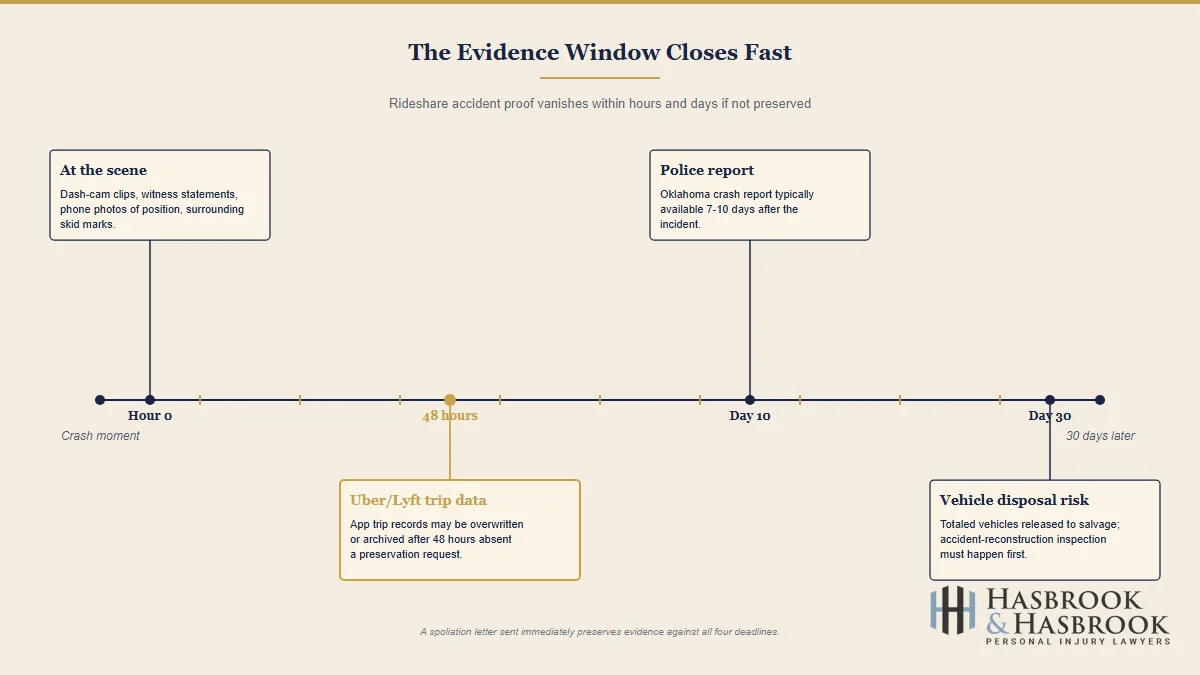
- Rideshare app records: Uber and Lyft maintain trip logs showing ride acceptance timestamps, GPS waypoints, and app-interaction records. These logs establish Phase 2 versus Phase 3 status and can show whether the driver was touching the app at the time of the crash. These records are subject to limited retention windows, so legal hold requests must be sent quickly after any serious incident.
- Police report and crash scene documentation: The responding officer’s report documents the physical facts of the crash, any citations issued, and a preliminary fault assessment. Photographs of the vehicles, roadway, and visible injuries taken at the scene supplement the police report and should be preserved immediately.
- Surveillance and dashcam footage: Commercial areas along SE 29th Street and intersections near Tinker AFB often have traffic cameras or nearby business surveillance. Footage may capture the crash or the moments leading up to it. Preservation requests for private camera footage must be made within days, as many systems overwrite automatically.
- Medical causation documentation: Linking your injuries to the collision requires medical records that establish causation, not just diagnosis. The timing between the crash and your first treatment visit is a factor in the standard-of-care and breach analysis that insurance adjusters perform.
- Independent contractor defense analysis: Uber and Lyft will argue that their drivers are independent contractors with no agency relationship to the company. Responding to this defense requires analyzing the company’s operational controls and reviewing the formal evidence-exchange phase of litigation for internal policies and driver communications that establish how much control the company exercises over driver conduct.
Steps to take after a Midwest City rideshare accident
What you do in the hours immediately after a crash affects both your health and your legal options. Rideshare accidents have specific evidence preservation needs that standard two-vehicle collisions do not share.
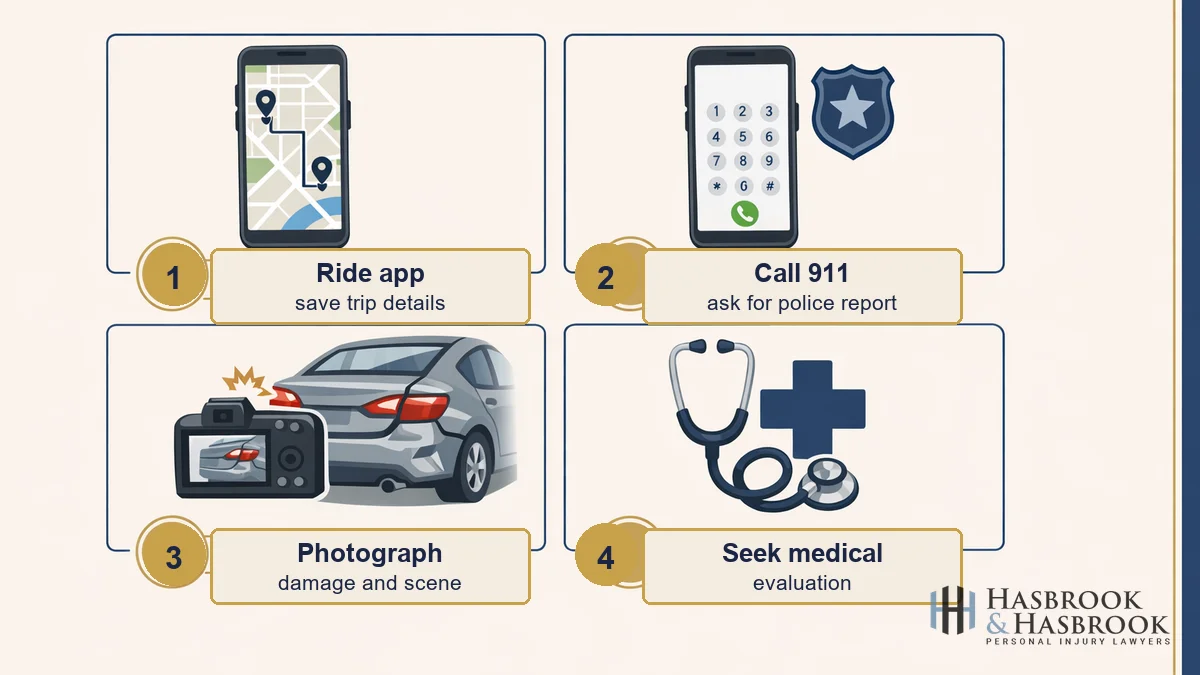
- Call 911. Request police and medical response even if injuries seem minor. A police report creates an official record and gives you the report number you will need for insurance claims.
- Screenshot the app before closing it. Take a screenshot of the active ride screen immediately. This creates proof of Phase 3 coverage status that does not depend on company records you would have to subpoena later.
- Photograph everything at the scene. Document the vehicles, road conditions, visible injuries, skid marks, traffic signs, and any dashcam visible in the rideshare vehicle. Photograph the driver’s insurance card and license plate.
- Collect driver information. Get the driver’s name, phone number, personal insurance information, and the in-app trip reference number.
- Seek medical care the same day. TBIs and spinal injuries can present with delayed symptoms. Gaps between the crash and first treatment are routinely used by adjusters to dispute causation.
- Do not give a recorded statement without speaking to an attorney first. You are not required to give a taped statement to the adjuster before consulting legal counsel. Early statements are regularly used to limit claims.
- Report the crash through the app. Notify Uber or Lyft to create an official incident record. This does not require accepting any version of events or waiving any rights.
For a full step-by-step guide, see the post-crash checklist for OKC rideshare passengers.
Why Uber/Lyft claims are harder than regular car accident claims
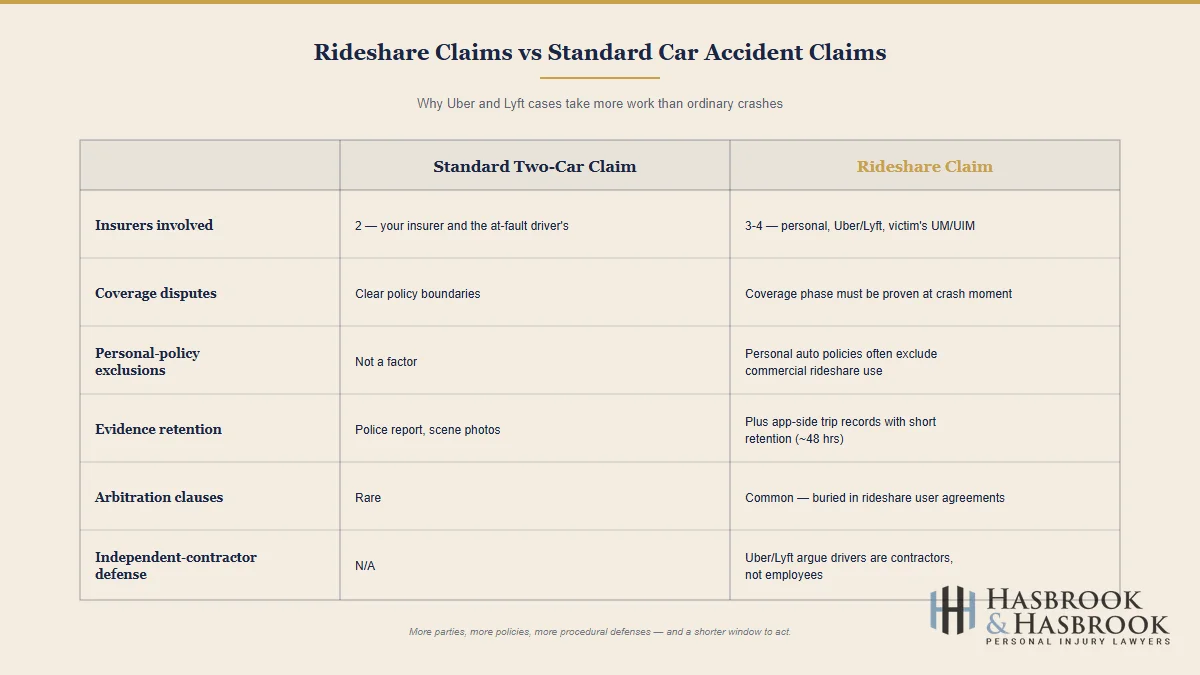
Rideshare accidents involve layers of insurance, coverage disputes, and company policies that do not appear in standard two-vehicle collisions. The primary complications are:
- Coverage-phase disputes: The difference between Phase 2 coverage ($100,000 maximum) and Phase 3 coverage ($1 million) can mean hundreds of thousands of dollars in available recovery. Uber and Lyft will contest which phase was active at the time of the crash, and the outcome depends on GPS and app-log records that the company controls.
- Independent contractor defense: Both companies maintain that drivers are independent contractors, not employees, which limits direct corporate liability for driver conduct. Overcoming this defense requires specific legal arguments and evidence of company control over driver operations.
- Personal policy exclusions: Many drivers carry standard personal auto policies that exclude commercial rideshare activity. If the driver’s personal insurer denies the claim because of this exclusion, recovery in Phase 2 depends entirely on the company’s contingent policy, which may be insufficient for serious injuries.
- Multiple-policy coordination: A serious rideshare accident may require simultaneous claims against the driver’s personal policy, the rideshare company’s phase-appropriate policy, and your own uninsured-and-underinsured-motorist protection. Each insurer operates on separate deadlines and assigns its own adjuster.
- Arbitration provisions: Both companies’ terms of service include arbitration clauses. Whether those clauses apply to third-party injury claims (rather than contract disputes between the driver and the company) is contested and must be analyzed on the facts of each case.
- Short evidence retention windows: Trip records, GPS logs, and driver communications are subject to company retention policies that may result in deletion within weeks. Sending a legal hold demand early is the only way to ensure this evidence is preserved before litigation begins.
For a broader overview of our Lyft injury practice page for the metro, including how the same coverage framework applies across both platforms, see the Lyft-specific page on our site.

How Oklahoma’s comparative fault rules can affect your recovery
Oklahoma follows a modified comparative fault system under 23 O.S. § 13. Your compensation is reduced in proportion to your assigned share of fault. Recovery is barred if your fault exceeds 50 percent. If your share of fault is 50 percent or less, you can still recover, but your damages are reduced by that percentage. For example, if you are found 20 percent at fault, your total damages are reduced by 20 percent.
This rule becomes significant in rideshare cases because more than two parties are often involved. In a crash where a Lyft driver ran a stop sign and another driver was speeding, both may be assigned a portion of fault. As a fare-paying passenger inside the rideshare, you generally carry no fault for the collision itself, which places you in a stronger claim position than either driver involved.
Insurance adjusters occasionally argue that a passenger contributed to a crash, for example by distracting the driver. These arguments rarely succeed when the circumstances are properly documented. For a fuller explanation of how Oklahoma handles shared fault, see our overview of how Oklahoma juries split blame between drivers or our detailed page on the factors that determine fault after an Oklahoma crash.
The deadline for filing a Midwest City rideshare accident claim
Under 12 O.S. § 95, personal injury claims in Oklahoma must be filed within two years of the date of the accident. Missing this deadline eliminates your right to seek compensation, regardless of how strong your claim would otherwise be. See our the two-year filing deadline for Oklahoma injury claims, or review tolling rules that may extend Oklahoma’s deadline in specific circumstances.
Two years sounds like ample time, but rideshare cases benefit from early action for specific reasons. Uber and Lyft retain trip data, GPS location records, and driver app status logs for limited periods. Once that retention window closes, obtaining this evidence requires litigation and may be contested by the company’s legal team. Physical evidence from the crash scene also deteriorates, and witnesses’ memories fade. Acting early preserves your options.
If the accident resulted in a fatality, different timing rules may apply under 12 O.S. § 1053 for a wrongful death claim brought by surviving family members. A Midwest City wrongful death attorney at Hasbrook & Hasbrook can review these claims at no charge.
Why choose Hasbrook & Hasbrook for your Midwest City rideshare case
Hasbrook & Hasbrook is an Oklahoma City personal injury firm that has represented injured Oklahomans for decades. Our personal injury team lead is licensed to practice in all Oklahoma state courts and handles rideshare accident cases from intake through resolution.
- No fee unless you recover: The firm works on a contingency fee basis, meaning you pay no attorney fees unless your case resolves in your favor. There are no upfront costs. Learn how no-fee-unless-you-win representation works in personal injury cases.
- Free initial consultation: You can discuss the facts of your accident at no charge. The consultation covers coverage phases, evidence preservation, and your options before you commit to anything.
- Direct attorney access: Your case is handled by an attorney, not managed by a case coordinator. Rideshare cases involving coverage-phase disputes and independent contractor arguments require attorney-level analysis throughout.
- Full personal injury practice: The firm handles the complete range of the firm’s full Midwest City injury practice. If your rideshare accident involved a commercial truck or produced catastrophic injuries, those aspects can be addressed within the same representation. View representative case outcomes for context on the firm’s record.
Frequently asked questions about Midwest City Uber and Lyft accidents
What should I do right after a Midwest City Uber or Lyft accident?
Call 911, screenshot the active rideshare app screen, and photograph the scene before anything is moved. Get the driver’s name, phone number, insurance information, and license plate. Seek medical evaluation that same day even if you feel uninjured at the scene. Do not give a recorded statement to any insurer before speaking with an attorney. The steps section above covers each action in detail.
Does Uber or Lyft’s $1 million policy cover me as a passenger?
Yes, if the driver had an active ride in progress when the crash occurred (Phase 3). The $1 million liability policy covers passengers and third parties during an active trip. If the driver was in Phase 2 (app on, no accepted ride), only the limited contingent coverage applies: up to $50,000 per injured person, $100,000 total per accident, and $25,000 for property damage. Phase 2 coverage is often insufficient for serious injuries.
What if the Uber driver does not have a rideshare endorsement on their personal insurance?
The driver’s personal insurer will likely deny the claim because standard auto policies frequently exclude commercial rideshare activity. In that scenario, only Uber or Lyft’s contingent Phase 2 coverage applies, which provides considerably less protection than the $1 million Phase 3 policy. This gap is why rideshare accident claims require a different analytical approach than standard car crash claims. Our page on strategies for pursuing recovery from underinsured drivers covers strategies for navigating coverage shortfalls.
Can I recover damages if another driver (not the Uber or Lyft driver) caused the crash?
Yes. Oklahoma’s comparative fault rules allow recovery from multiple at-fault parties. If a non-rideshare driver ran a red light and contributed to the crash while you were a passenger, that driver’s insurance is also a potential source of compensation. Your attorney can identify all parties who may bear responsibility and pursue claims against each of them simultaneously.
What if the at-fault driver is underinsured?
You may be able to access uninsured or underinsured motorist coverage for the gap. Under 36 O.S. § 3636, Oklahoma insurers are required to offer UM and UIM coverage to policyholders. Depending on which phase of the trip was active at the time of the crash, the rideshare company’s own UM/UIM coverage may also apply. Our parent page on OKC rideshare claims covers the full insurance framework for rideshare claims.
How long does an Uber or Lyft accident claim take to resolve?
Most rideshare injury claims settle within 6 to 18 months without going to trial. The timeline depends on the severity of your injuries, whether you have reached maximum medical improvement, whether Uber or Lyft disputes the coverage phase, and whether litigation is required. See typical resolution timelines for Oklahoma injury cases for a breakdown of the factors that affect case timelines.
What if I was partially at fault for the crash?
You can still recover as long as your fault does not exceed 50 percent. Under 23 O.S. § 13, your compensation is reduced by your percentage of fault, but recovery is not barred unless your fault exceeds 50 percent. As a passenger in a rideshare vehicle, you typically bear no fault for the collision itself, which puts you in a favorable position compared to either driver involved.
Can I sue Uber or Lyft directly for my injuries?
Uber and Lyft are not automatically liable for their drivers’ conduct because of the independent contractor classification. However, both companies can be named in litigation under various theories depending on the facts, and their coverage obligations are contractual regardless of the employment classification argument. Whether to name the company as a direct defendant is a core question your attorney evaluates at the outset. See our how to evaluate whether your facts support an injury claim for more context.


Talk to a Midwest City Uber/Lyft accident attorney
Rideshare insurance disputes require knowing which coverage tier applied at the time of the crash, how Oklahoma’s comparative fault rules affect your recovery, and what evidence needs to be preserved before companies and insurers close their files. Hasbrook & Hasbrook has represented injured Oklahomans for decades. Call 405-605-2426 for a free consultation, or submit your information through the secure contact page. If your accident also involved a commercial vehicle, our Midwest City commercial-vehicle practice page covers those claims as well.