Airbag injuries are compensable in Oklahoma. The driver who caused your crash is liable for every injury the wreck produced, including facial fractures, chemical burns, and eye or brain trauma from airbag deployment. You have two years from the crash date to file suit under 12 O.S. § 95, but deployment evidence fades far sooner.
Airbags save lives in serious collisions, but deployment force causes real injuries of its own. If an airbag hurt you in an Oklahoma City wreck, our attorneys at Hasbrook & Hasbrook pursue compensation for every injury the crash caused, including the ones the airbag inflicted.

Key Takeaways
- Airbag injuries belong in your car accident claim. The at-fault driver is responsible for deployment injuries, not just collision injuries.
- Oklahoma allows two years to file. The deadline in 12 O.S. § 95 runs from the crash date; missing it bars the claim.
- Partial fault does not bar recovery. Under 23 O.S. § 13, you can recover as long as you were not more than 50% at fault.
- Noneconomic damages are capped at $500,000 for injuries on or after September 1, 2025, by 23 O.S. § 61.3, a new statute that has not yet been tested in court. The statute sets no cap for permanent and severe physical injury, such as substantial disfigurement, loss of use of a limb, substantial impairment of a major body organ or system, or an injury that leaves you unable to care for yourself independently. Other exceptions are covered in the damages section below.
How do airbags work?
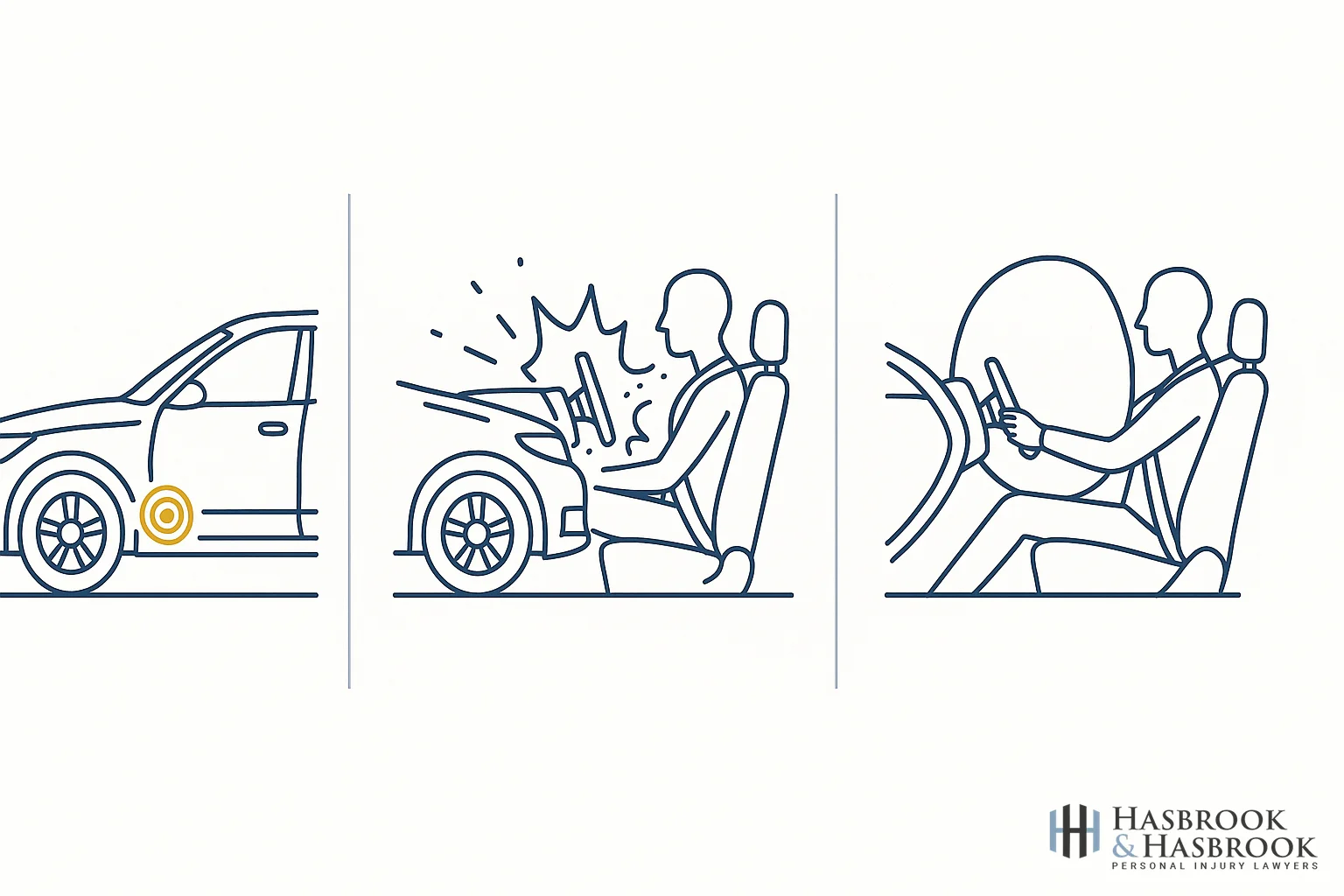
Crash sensors detect sudden deceleration and trigger the inflator within milliseconds. The inflator releases a burst of nitrogen gas that fills the nylon bag at speeds approaching 200 miles per hour, and the full sequence takes roughly 30 milliseconds. That speed cushions you before you strike the steering wheel, and it also makes the bag dangerous when you sit close, ride out of position, or take a deployment in a lower-speed crash. According to NHTSA airbag safety data, frontal airbags have saved more than 50,000 lives since 1987.
Deployment force, angle, chemical exposure, and seating position shape your injuries, and we document each variable to show how the airbag caused or compounded your harm.



What injuries can airbags cause in an Oklahoma car accident?
When your face, chest, or hands sit in the deployment path, the safety device itself becomes a source of harm. We regularly see car wreck claims in Oklahoma City where the airbag injuries are worse than the collision injuries.
Deployment injuries follow a recognizable pattern: symmetrical facial abrasions, propellant burns on the forearms, and grip fractures of the thumbs. That pattern is how physicians separate airbag harm from collision harm, and it is why early imaging matters.
Common deployment injuries include:
- Facial fractures and lacerations around the nose, cheekbones, and orbital bones. Many of our facial fracture and broken bone cases start exactly this way.
- Chemical burns to the skin, eyes, and airway from propellant gases, the same harm we pursue in chemical burn injury cases.
- Eye injuries, including corneal abrasions, retinal detachment, and partial or total vision loss.
- Head trauma ranging from concussion to diffuse axonal injury, the basis of many of the head trauma claims we litigate.
- Rib fractures and chest contusions from the bag striking the sternum, which we also see in rib and chest trauma claims.
- Wrist, hand, and neck injuries when hands are on the wheel or the head snaps back during deployment.
Severe deployment injuries that cause permanent disability or disfigurement may qualify as permanently disabling injury cases under Oklahoma law. When airbag trauma proves fatal, surviving relatives can bring a wrongful death claim for surviving family.

What compensation can you recover after an airbag injury in Oklahoma?
You can recover every category of loss the crash caused. The value depends on injury severity and the strength of the liability evidence.
| Damage Category | What It Covers | Example |
|---|---|---|
| Medical expenses | Emergency care, surgery, rehabilitation, and future treatment | $120,000 in reconstructive facial surgery after a high-speed deployment |
| Lost wages and earning capacity | Income lost during recovery and reduced future earnings | $32,000 in lost pay during an 8-month eye-injury recovery |
| Pain and suffering | Physical pain, emotional distress, and anxiety | Chronic facial pain after an airbag-related fracture |
| Disfigurement and scarring | Permanent scarring, burns, or physical changes | Propellant burns on the face and arms |
| Punitive damages | Additional damages for reckless conduct under 23 O.S. § 9.1 | A drunk driver who caused the deployment crash |
When the injury happened on or after September 1, 2025, noneconomic damages are capped at $500,000 in most cases, but 23 O.S. § 61.3, a new statute that has not yet been tested in court, sets no cap for a permanent and severe physical injury. Airbag injuries concentrate on the face, eyes, and head, so they often meet that exception. The limit also disappears if the judge and jury conclude, on clear and convincing evidence, that the defendant’s conduct was in reckless disregard for the rights of others, grossly negligent, fraudulent, or intentional or malicious. Wrongful death actions and claims brought under the Governmental Tort Claims Act fall outside the cap. Section 61.3 does not limit economic damages.
What does Oklahoma law say about airbag injury cases?
Negligence: the driver who caused the collision is responsible for every injury it produced, including injuries from the force of deployment. You prove the crash, the deployment, and the causal link.
Comparative negligence: under 23 O.S. § 13, you recover as long as you were not more than 50% at fault, with your damages reduced by your share of fault under 23 O.S. § 14.
Filing deadline: 12 O.S. § 95 gives you until the second anniversary of the crash to file a personal injury suit. Miss it and the claim is permanently barred.



How insurers handle airbag injury claims
The insurance company on the other side of an auto accident claim with airbag injuries works from a familiar playbook; see our breakdown of adjuster tactics in car accident claims.
Blaming your position: adjusters argue you sat too close or had the seat too far forward. Position can affect severity, but the driver who triggered the deployment remains responsible.
Calling it preexisting: any prior neck, back, or facial injury becomes the supposed real cause. Treating-physician records and imaging counter this.
Splitting the injuries: the adjuster credits every injury to the collision so the deployment injuries drop out of the valuation. The injury-pattern records put them back in.
Lowball early offers: a fast settlement locks in a number before delayed injuries such as retinal detachment declare themselves.
Your airbag injury claim: step by step

Step 1: Free consultation. We review the crash, the deployment, and your injuries, with no obligation.
Step 2: Evidence preservation. We move immediately to preserve the vehicle’s event data recorder and scene documentation. A preservation letter goes out before the insurer totals and auctions the car; once the vehicle is scrapped, the deployment record usually goes with it.
Step 3: Demand and negotiation. Once your condition stabilizes, our demand documents the collision injuries and the airbag injuries separately to capture the claim’s full value. We handle every adjuster conversation.
Step 4: Filing suit if needed. If the insurer will not pay fair value, we file in Oklahoma district court. Many cases settle once the insurer sees we are prepared to try it.
Step 5: Discovery and trial. Both sides exchange evidence and depose witnesses, often including biomechanical engineers and ophthalmologists. If the final offer is still short, a jury decides.
What to do after an airbag injury
- Get examined the same day. Retinal detachment, mild brain trauma, and internal bleeding do not always produce immediate symptoms.
- Keep the vehicle. Do not scrap it or authorize repairs before the event data recorder and damage pattern are preserved.
- Document everything. Photograph bruising, burns, and eye redness daily, and start building a day-one record of your injuries.
- Decline recorded statements. The other driver’s insurer will call quickly; anything you say gets used to shrink the claim.
- Get a lawyer involved early. Evidence degrades, vehicles get auctioned, and the filing clock is already running.

Why choose our Oklahoma City airbag injury attorneys?

Hasbrook & Hasbrook is an Oklahoma City firm of personal injury lawyers, and Clayton T. Hasbrook has built the practice around serious wreck cases. Airbag claims demand specific medical documentation: facial reconstruction records, ophthalmology reports, and neurological evaluations that tie each injury to the deployment.
Our cases have run from facial fractures and chemical burns to brain injuries and permanent vision loss, and we know how insurers attack these claims.
How our fees work
Our contingency fee is 25% when your case settles before a lawsuit is filed, and on any settlement our fee is never more than what you take home after medical bills and case costs are paid. You pay nothing up front, and you owe no fees and no case costs unless we recover money for you.
We advance all case expenses and recover them only from your settlement or verdict. That structure lets you hire a personal injury lawyer regardless of your financial situation.
Frequently asked questions about Oklahoma airbag injuries
How much is an airbag injury case worth in Oklahoma?
It depends on injury severity and the strength of the liability evidence. Cases involving serious facial injuries, brain trauma, or blindness can resolve in six or seven figures. Noneconomic damages fall under the $500,000 cap in 23 O.S. § 61.3, a new statute that has not yet been tested in court, for injuries on or after September 1, 2025, unless you suffer a permanent and severe physical injury (an exception airbag injuries often satisfy) or another statutory exception applies. Section 61.3 does not cap economic damages.
How long do I have to file an airbag injury lawsuit in Oklahoma?
Two years from the date of injury under 12 O.S. § 95. Building the medical documentation takes months, so the practical deadline is much earlier than the legal one.
Can I recover punitive damages for an airbag injury?
Punitive damages are available when the at-fault driver showed reckless disregard for the rights of others, proven by clear and convincing evidence. 23 O.S. § 9.1 caps them at the greater of $100,000 or your actual damages, with higher limits for intentional, malicious conduct. Drunk-driving crashes are the most common fit.
Can I still recover compensation if I was partly at fault for the accident?
Yes. Under 23 O.S. § 13 you can recover as long as you were not more than 50% at fault, and under 23 O.S. § 14 your recovery is reduced by your percentage of fault rather than eliminated.
Can I sue the airbag manufacturer for my injuries?
A defective airbag claim is a product liability case, a separate legal theory our firm does not handle. This page covers airbag injuries as part of a negligence claim against the at-fault driver, the right theory when a normally functioning airbag hurt you. If you suspect a defect, the NHTSA Takata recall spotlight explains the largest airbag recall, and you can run your VIN through the NHTSA recall lookup tool.
What if the airbag did not deploy during my accident?
Non-deployment matters two ways: the missing protection may have worsened your injuries, which factors into damages, and if defective airbags or sensors caused the failure, a product liability claim against the manufacturer may exist (handled separately from this firm’s practice). Note it in the accident report, photograph the dash, and preserve the vehicle for inspection.

Ready to talk to an Oklahoma City airbag injury lawyer?

Tell us what happened, and we will tell you where your claim stands. Call (405) 605-2426 for a free consultation with Clayton Hasbrook. There is no pressure and no fee unless we win.
Evidence disappears fast: vehicles get auctioned, footage gets overwritten, and the deadline under 12 O.S. § 95 is already running. Call now or reach our office online today to protect your claim.