A fully loaded tractor-trailer can weigh 80,000 pounds, roughly 20 times the weight of your car. When a truck that size collides with a passenger vehicle on an Oklahoma highway, the physics are devastating. If you or someone you love was hurt in a truck accident, you already know how overwhelming the aftermath is: mounting medical bills, lost wages, and insurance adjusters calling before you’ve left the hospital.
Key takeaways
- Truck accident claims involve multiple defendants. The driver, trucking company, freight broker, cargo loader, and third-party maintenance contractors can each share liability, which means multiple insurance policies may cover your damages.
- FMCSA violations are powerful evidence of negligence. When a driver or carrier violates federal hours-of-service, maintenance, or testing rules, those violations help establish a breach of the duty of care owed on the road.
- The ECM 30-day window is critical. A truck’s electronic control module records speed, braking, and engine data before a crash, and trucking companies can overwrite that data during routine maintenance cycles. A preservation letter must go out immediately.
- Oklahoma’s comparative fault bar can cut off your claim. Under 23 O.S. § 13, you recover nothing if a jury finds you more than 50% at fault. Defense teams will try to assign blame to you.
- Commercial insurance pools are substantial. Trucking policies typically range from $750,000 to $5 million. Identifying every liable party and every applicable policy maximizes the compensation available.



Why you need an Oklahoma truck accident lawyer
Truck accident claims differ fundamentally from standard car accident cases. A fender bender involves two drivers and two policies. A truck wreck can involve the driver, trucking company, freight broker, cargo loader, and a maintenance contractor, each with their own insurer and legal team. The trucking company’s rapid response team may dispatch investigators to the scene before emergency responders clear the wreckage. Their adjusters are trained to minimize payouts on claims that frequently exceed $500,000 (see the insurer’s internal claim-handling workflow). Do not give a recorded statement to any insurance representative before speaking with an attorney. See our guides on the day-to-day work of a commercial-vehicle attorney and the benefit of bringing in a semi-crash lawyer early.
Federal Motor Carrier Safety Administration (FMCSA) regulations govern nearly every aspect of commercial trucking. Preserving the truck’s electronic control module (ECM) data, the “black box,” is critical: it records speed, braking, and hours of operation before the crash, and carriers can overwrite that data in routine 30-day maintenance cycles without a legal hold. The lawyers at Hasbrook & Hasbrook send that letter immediately, identify which FMCSA rules the driver or carrier violated, and build the case before evidence disappears. See our overview of pulling the truck’s onboard crash-data recorder and a realistic timeline from filing to resolution.
Common causes of Oklahoma truck accidents
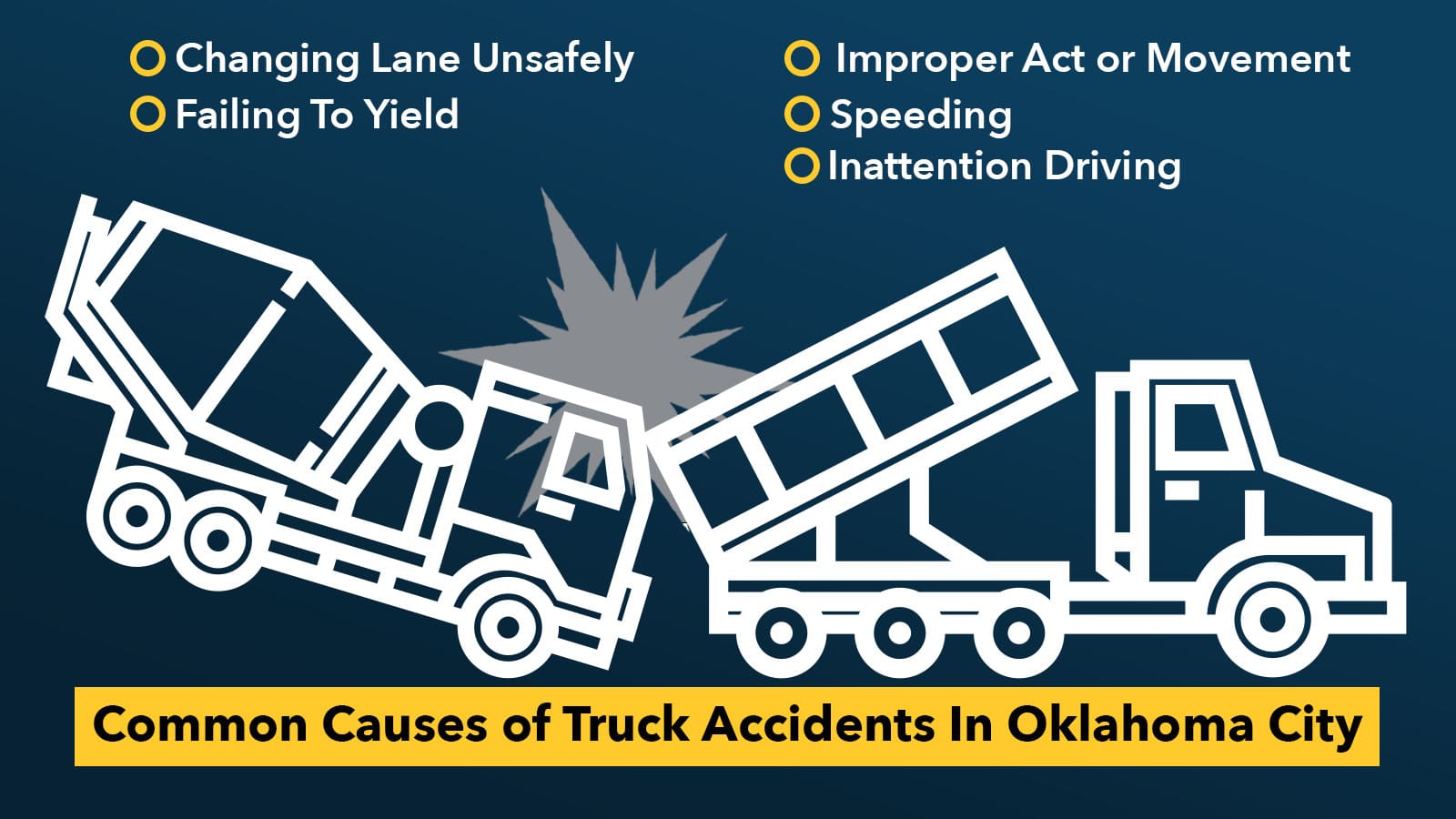
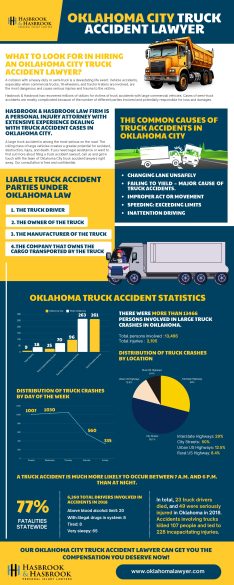
The most common causes of truck accidents in Oklahoma include driver fatigue, distracted driving, improper cargo loading, inadequate maintenance, speeding, impairment, and inadequate driver training. Each cause ties directly to a specific FMCSA regulation that establishes the carrier’s standard of care. Our overview of the crash-cause coding we see in OKC police reports covers the passenger-vehicle side; the dynamics below apply specifically to commercial trucks.
- Driver fatigue: FMCSA hours-of-service rules limit property-carrying drivers to 11 hours of driving within a 14-hour window. Fatigue impairs reaction time as severely as alcohol.
- Distracted driving: FMCSA prohibits texting and handheld phone use by commercial drivers, with penalties up to $2,750 per driver violation and $11,000 per carrier violation. Dispatching devices and GPS programming are equally dangerous.
- Improper cargo loading: Shifted or unsecured freight causes rollovers and jackknifes. When a shipper or loading crew violates federal weight and securement standards, a 40-ton truck can become uncontrollable on a curve.
- Inadequate maintenance: Brake failures, tire blowouts, and lighting problems often trace back to deferred maintenance documented in FMCSA inspection records, which can establish direct carrier liability.
- Speeding: A loaded semi at 65 mph needs roughly 525 feet to stop. That distance grows sharply at 75 mph, making I-35, I-40, and I-44 especially hazardous when drivers exceed limits.
- Impairment: CDL holders face a lower legal BAC of 0.04% (vs. 0.08%), and FMCSA mandates pre-employment, random, post-accident, and reasonable-suspicion drug and alcohol testing. Carriers that skip testing put impaired drivers on public roads.
- Inadequate training: Carriers who rush inexperienced drivers through orientation without adequate behind-the-wheel instruction on specific equipment bear direct liability when that inexperience causes a crash.
Types of commercial vehicles involved in Oklahoma crashes
“Truck” can mean a 5,000-pound delivery van or an 80,000-pound tanker. The vehicle type matters because it shapes which federal rules apply, which policies are in play, and which defendants belong in the lawsuit.
- 18-wheelers and tractor-trailers: The full range of FMCSA rules applies, including hours of service, ELD logging, and CDL Class A. Liability often reaches the motor carrier, freight broker, and cargo shipper.
- Box trucks and straight trucks: Used by local movers, appliance retailers, and small fleets. Federal hours-of-service rules still apply above 10,001 pounds GVWR, and drivers under 26,000 pounds do not need a CDL, so training gaps are common.
- Tanker trucks: Liquid surge inside a partially filled tank shifts the center of gravity, making rollovers and jackknifes more likely. Hazmat loads add federal regulatory layers and spill-related exposure.
- Flatbed trailers: Cargo is exposed and held by chains, straps, and tarps. 49 CFR Part 393 cargo-securement rules specify tie-down counts and working-load limits; violations are common in lumber, steel, and equipment hauls.
- Delivery vans: FedEx, UPS, Amazon DSP partners, and last-mile contractors create complex employment questions. Employee-versus-contractor status often controls whether the parent brand is on the hook.
- Garbage and refuse trucks: Frequent stops, right-side blind spots, and tight route timing create predictable risks for cyclists and pedestrians on residential streets.
- Construction vehicles: Dump trucks, cement mixers, and rigid-frame haulers operate on Oklahoma highways and in work zones. Loose gravel, oversize loads, and improperly secured equipment can implicate the contractor, project owner, and equipment lessor.
Types of truck accidents in Oklahoma City
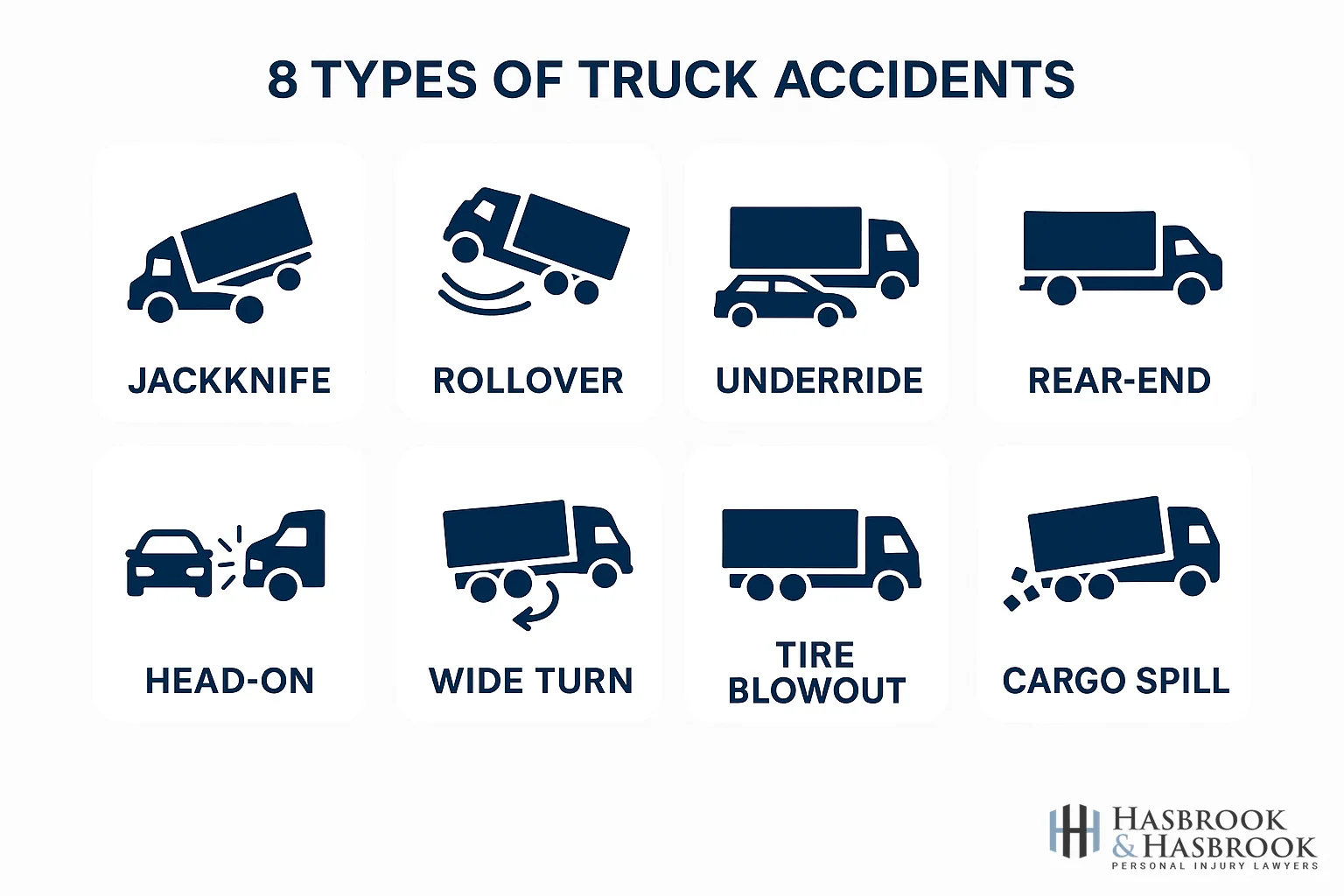
Truck accidents in Oklahoma City take many forms. The crash type determines which safety regulations were violated, which parties bear liability, and what evidence your attorney must preserve first. See our guides on how we work up rollover semi cases in Midwest City, how we prove visibility-failure semi wrecks in Midwest City, and lateral-strike truck collision cases in Midwest City.
Jackknife accidents
A jackknife occurs when a driver brakes hard or too sharply, causing the trailer’s wheels to lock while the cab continues forward and the trailer swings perpendicular. These crashes can sweep across multiple lanes at once, making them among the most dangerous accidents on Oklahoma interstates.
Rollover accidents
Rollovers occur when a truck tips onto its side, often after taking a curve too fast or carrying an improperly distributed load. When loading contributed, the shipper or loading company may share liability. Our overview of what causes vehicles to tip and how those cases are proved covers the physics.
Underride and override accidents
Underride crashes happen when a smaller vehicle slides beneath a truck’s trailer, often shearing the roof off at window height. Both underride and override crashes frequently raise questions about whether the trailer’s underride guards were adequate and whether the carrier maintained them, in addition to driver negligence.
Rear-end collisions with trucks
At highway speeds, an 80,000-pound truck’s stopping distance is dramatically longer than a passenger vehicle’s. Evidence centers on driver distraction, following distance, and whether the braking system met FMCSA maintenance standards.
Head-on collisions
Head-on collisions between commercial trucks and passenger vehicles are nearly always fatal or catastrophic for smaller-vehicle occupants. Driver fatigue is the leading cause, and ELD records showing hours-of-service violations are often the most critical evidence.
Wide turn and squeeze play accidents
When a semi swings wide left before turning right, vehicles in the truck’s right blind spot can be trapped between the trailer and the curb. These crashes commonly occur at intersections on I-240 and on city arterials through the metro.
Tire blowout accidents
When a tire fails at highway speed, the truck can lose stability instantly and veer into adjacent lanes. Blowouts frequently result from deferred maintenance, and a carrier that ignores FMCSA pre-trip inspection requirements faces direct liability.
Cargo spill accidents
When improperly secured cargo breaks free, it creates an instant multi-vehicle hazard. Federal cargo securement rules (49 CFR Part 393) specify how each cargo type must be tied down, and violations expose the driver, carrier, shipper, and loading contractor.
Types of truck crash injuries
The mass and energy of a commercial truck produce a different injury pattern than ordinary auto crashes. Documenting the injury type early matters because the medical specialty, lifetime cost projection, and damages model all flow from that diagnosis.
- Traumatic brain injury (TBI): Concussions, contusions, diffuse axonal injury, and skull fractures. Even “mild” TBI can produce lasting cognitive, mood, and sleep symptoms. See our head-trauma and post-concussion case workups, early head-trauma warning signals to monitor at home, and what head-trauma claims tend to recover in Oklahoma.
- Spinal cord injury: Compression, fracture-dislocation, or transection producing partial or complete paralysis. These cases turn on detailed motor and sensory findings and attendant-care costs. See our cord and paralysis case workups and what paralysis claims tend to recover in this state.
- Crush injuries and orthopedic trauma: Multiple fractures, pelvic injury, and degloving from cab intrusion or rollover, often requiring staged surgery. Our guide on fracture-injury claim representation walks through recovery and damages.
- Internal organ damage: Lacerated spleen, liver, kidney, or perforated bowel from blunt-force trauma. Symptoms can be delayed; see warning signs of post-crash hemorrhage that surface days later.
- Severe burns: Cargo fires, fuel-tank ignition, and post-crash entrapment cause second- and third-degree burns often requiring grafting. See our thermal-injury cases tied to post-wreck vehicle fires and Oklahoma damage ranges for burn-injury claims.
- Amputations: Traumatic limb loss or surgical amputation after crush, vascular, or burn injury. Damages include prosthetics, fitting cycles, occupational therapy, home modification, and the wage-loss curve.
- Catastrophic and fatal outcomes: See our pages on life-altering harm representation and claims after the loss of a loved one.


Oklahoma and federal trucking regulations
Oklahoma truck cases sit on two layers: state negligence law, including modified comparative fault under 23 O.S. § 13 and the two-year statute of limitations under 12 O.S. § 95, and a thick layer of federal motor carrier rules that set the standard of care. FMCSA violations are not their own cause of action but serve as powerful evidence of negligence in an Oklahoma tort claim.
- Hours of service (49 CFR Part 395): 11-hour driving cap within a 14-hour window after 10 hours off duty, 30-minute break after 8 driving hours, and 60/70-hour weekly limits. ELDs record this automatically, which is why ELD preservation is a first-week priority.
- Driver qualification (49 CFR Part 391): CDL verification, road test, three-year MVR, DOT medical certificate, and a driver qualification (DQ) file. Negligent hiring claims often start by subpoenaing the DQ file.
- Equipment standards (49 CFR Part 393): Brake performance, lighting, tires, coupling devices, underride guards, and cargo securement. Roadside inspection and out-of-service records create a paper trail that contradicts a “well-maintained fleet” defense.
- Drug and alcohol testing (49 CFR Part 382): Pre-employment, random, post-accident, reasonable-suspicion, return-to-duty, and follow-up programs. Skipped post-accident testing or failure to remove a positive driver is direct-liability territory.
- Inspection and maintenance (49 CFR Part 396): Pre-trip and annual inspection requirements, repair documentation, and out-of-service criteria. Maintenance records often expose the pattern behind a brake or tire failure.
- Oklahoma intrastate rules: Trucks operating only within Oklahoma fall under Oklahoma Corporation Commission rules that largely mirror the federal FMCSA framework. See our guide on fines and sanctions that follow federal trucking infractions.
Oklahoma’s 50% bar rule lets you recover only if your share of fault does not exceed 50%; over that threshold, you recover nothing. Read our guides on how Oklahoma juries actually apportion shared blame, the way Oklahoma slices shared-blame recoveries at 50 percent, and what happens to recovery when you bear partial fault. Under respondeat superior, a carrier is liable for its employee drivers’ negligence within the scope of employment. Some carriers try to classify drivers as independent contractors to dodge this, but Oklahoma courts look at the actual degree of control the carrier exercises, not the label on the contract.
What compensation can you recover after a truck accident?
You can recover for medical expenses paid, lost wages, diminished earning capacity, pain and suffering, property damage, and, in cases of egregious conduct, punitive damages. Oklahoma follows a “paid, not incurred” rule. Under 23 O.S. § 61.3, noneconomic damages are generally capped at $500,000, with exceptions for permanent catastrophic injuries; the current cap took effect in September 2025 and has not yet been tested by the Oklahoma Supreme Court. Punitive damages under 23 O.S. § 9.1 depend on the defendant’s conduct and the category found. See what big-rig collision claims commonly resolve for, the § 3009.1 paid-versus-incurred evidentiary framework, and when juries impose extra-compensatory awards for reckless behavior, with documented Oklahoma cases where juries imposed extra damages.
| Damage Category | What It Covers | Oklahoma-Specific Rules |
|---|---|---|
| Medical Expenses (Past) | ER, surgery, hospitalization, rehab, therapy, medications, devices | “Paid, not incurred” rule |
| Medical Expenses (Future) | Anticipated surgeries, ongoing therapy, long-term care, medications | Requires expert medical testimony on necessity and cost |
| Lost Wages | Income missed during recovery | Documented via employer records and tax returns; see documenting time-off work and diminished future earnings |
| Lost Earning Capacity | Diminished ability to earn from permanent injury | Often requires vocational expert testimony |
| Pain and Suffering | Physical pain, emotional distress, loss of enjoyment of life | Generally capped at $500,000 under 23 O.S. § 61.3 (untested); see how Oklahoma juries calibrate non-economic damages |
| Property Damage | Vehicle repair or replacement | Fair market value at time of loss; no cap |
| Punitive Damages | Reckless, grossly negligent, or intentional conduct | Availability and cap depend on the category under 23 O.S. § 9.1 |
| Wrongful Death | Funeral costs, loss of support and companionship, grief | Filed by personal representative under Oklahoma’s wrongful death statute; 2-year deadline |
Seeking maximum compensation for your truck accident injuries
Maximum compensation is rarely a single check from a single insurer. It is the product of identifying every category of damages, every defendant whose conduct contributed, and every applicable policy.
- Build economic damages to actual cost. Past bills paid, future needs from treating-physician projections, past wage loss from employer records, and lost earning capacity from vocational and economic experts. See the full the complete loss-recovery model after a passenger-vehicle crash.
- Document non-economic damages. Pain, loss of enjoyment of life, and spousal loss of consortium require pain journals, treating-provider functional notes, and lay-witness testimony, not generic “10/10 pain” talk. See general pain-and-suffering calculation principles in Oklahoma.
- Identify punitive exposure early. Falsified logs, post-crash spoliation, prior similar violations on the carrier’s record, and impairment the carrier knew or should have known about can open the door under § 9.1.
- Stack every applicable policy. Primary commercial liability, excess and umbrella layers, the broker’s contingent coverage, the shipper’s GL policy, maintenance contractor coverage, and your own first-party coverage that fills the gap on underinsured drivers. See what to do when damages exceed available coverage.
- Push back on bad-faith handling. A carrier insurer that refuses to negotiate in good faith can trigger an an extra claim against the insurer under § 1250.5 claim with its own damages exposure.
Who can be held liable in an Oklahoma truck accident?
Multiple parties can be liable, including the truck driver, the trucking company, the freight broker, the cargo shipper or loader, and third-party maintenance providers.
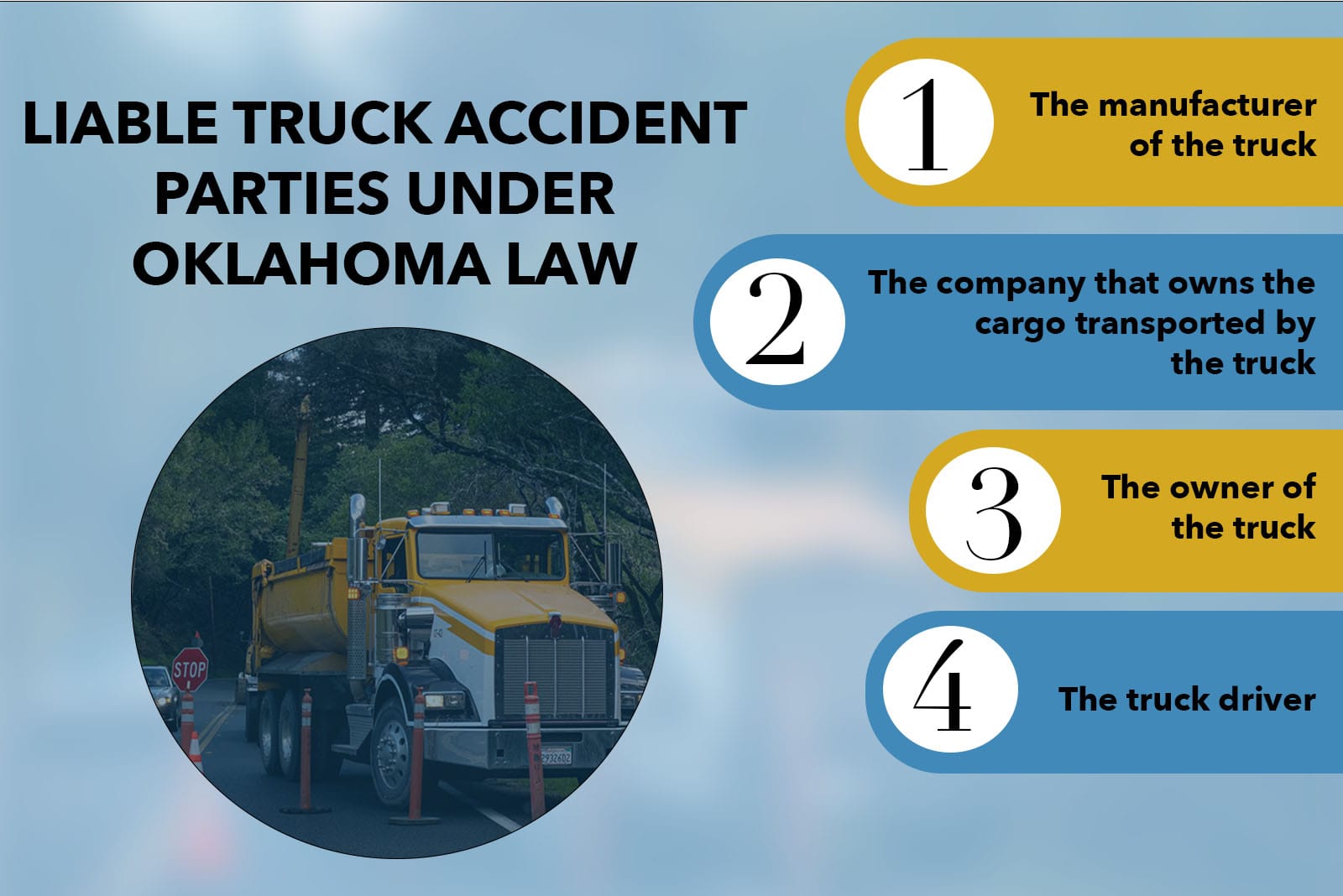
The truck driver may be liable for speeding, distracted driving, fatigue, impairment, or failure to perform required pre-trip inspections. Suing only the driver usually provides limited recovery because individual drivers rarely carry substantial personal assets. See our FAQ on deciding which trucking parties to put in the lawsuit.
The trucking company is typically the primary defendant. Under respondeat superior, the carrier is vicariously liable for its drivers’ negligence within the scope of employment. It may also be directly liable for negligent hiring, retention, supervision, and maintenance. See how we pinpoint responsible parties after a semi wreck and why commercial-truck crashes have grown in Oklahoma.
Freight brokers and shippers may share liability when a broker selects an unsafe carrier or a shipper’s loading crew violates cargo securement rules. See our wrecks that involve business-operated trucks and vans guide.
Identifying every liable party expands the insurance pool: the carrier’s commercial liability policy ($750,000 to $5 million), the broker’s contingent coverage, and the shipper’s general commercial liability policy.
How we build your truck accident case
A truck case is won or lost in the first 30 to 90 days. The work below separates a serious truck-claim file from a generic auto-claim file.
- Spoliation letter and ELD preservation. A written legal-hold letter goes to the carrier on day one directing preservation of ECM data, ELD logs, dashcam video, dispatch communications, post-accident drug/alcohol test results, and daily inspection reports.
- Driver qualification file subpoena. The DQ file shows the application, road-test results, MVR history, prior employer verifications, medical certification, and any disciplinary history. A pattern of violations the carrier knew about supports negligent retention.
- Maintenance records. Daily inspection reports, work orders, brake and tire records, and prior FMCSA roadside inspection results. Deferred maintenance is a common direct-liability theory.
- FMCSA safety record pull. The carrier’s SAFER snapshot and CSA BASIC scores show prior crashes, out-of-service rates, and inspection history.
- Accident reconstruction experts. Speed analysis, sight-line modeling, and ECM interpretation. See the engineers who rebuild the timing and forces of the wreck.
- Medical and life-care planning. Treating-physician causation and prognosis opinions, plus a life-care planner’s projection of future surgical, therapy, equipment, and attendant-care costs. See our guide on why medical documentation drives claim valuation.
- Deposition strategy. The driver, the safety director, and the carrier’s 30(b)(6) corporate representative on policies and recordkeeping.

What steps should you take after a truck accident?
Call 911, seek immediate medical attention even if you feel okay, document the scene, avoid recorded statements to insurers, and contact a truck accident attorney within 48 hours.
At the scene, if you can:
- Call 911 and request police and EMS
- Photograph the truck (DOT number, company name, license plate), your vehicle, road conditions, skid marks, and your visible injuries
- Get witness contact information and a short description of what they saw
- Do not discuss fault with the driver, the company’s representative, or any insurance adjuster
In the hours and days after:
- Go to the ER or urgent care; adrenaline masks pain, and injuries including traumatic brain injuries and herniated discs may not produce symptoms for hours or days
- Follow up with your primary care doctor and any referred specialists
- Keep a daily journal of pain levels, limitations, and how the injuries affect your daily life
- Do not post about the accident on social media
- Contact a truck accident attorney before any insurance adjuster; see whether to give the insurer a recorded statement
What to expect during your truck accident claim
Expect an investigation and evidence preservation phase, followed by medical documentation, demand preparation, negotiations, and, if the insurer refuses a fair offer, litigation through Oklahoma’s district court system. The process typically takes 12 to 24 months. For broader context, see how a car accident lawsuit works.
| Phase | Typical Duration | What Happens |
|---|---|---|
| 1. Immediate Investigation | First 1 to 4 weeks | Preservation letter; police report; scene documentation; ECM data; witness statements |
| 2. Medical Treatment | Weeks to months | Follow prescribed treatment; document every appointment; reach the recovery milestone that locks in future-care projections |
| 3. Case Building | 2 to 6 months after MMI | Records compiled; expert reports obtained; damages calculated |
| 4. Demand and Negotiation | 1 to 3 months | Demand letter sent; counteroffers exchanged; mediation may be attempted |
| 5. Litigation | 6 to 18 months | Suit filed; discovery; motions; trial preparation; trial or settlement at any point |
| 6. Resolution | Varies | Settlement or verdict; liens resolved; fees and costs deducted; net proceeds to you |
Why choose Hasbrook & Hasbrook for your Oklahoma City truck case
Hasbrook & Hasbrook is a family-run Oklahoma personal injury firm that handles every truck case personally rather than passing intake to a call center. Direct attorney access from the first call through resolution is the model.
Clayton, the firm’s lead trial lawyer leads the firm’s truck accident practice and handles those cases from the first preservation letter through trial when needed. Truck claims demand sustained engagement with FMCSA records, expert witnesses, and multi-defendant discovery; that work is not delegated to staff. The firm advances all case expenses, including accident reconstruction, expert witnesses, and medical record costs, and recovers those costs only from your settlement or verdict.
The firm handles the full spectrum of serious truck accident injuries, from the diagnoses that recur across our passenger-vehicle caseload through life-altering outcomes. Past results do not guarantee a specific outcome; see additional outcomes on our the verdicts and settlements our firm has secured.
How our fees work
Every truck case is handled on a contingency fee. You pay no attorney fees unless we recover compensation for you. The firm advances all case expenses, including filing fees, expert witnesses, and accident reconstruction, and recovers those only from your settlement or verdict.
The fee structure is set before you sign, in writing, with no surprises. See our overview of what Oklahoma personal-injury lawyers typically charge for a walkthrough of how contingency fees work in Oklahoma personal injury cases.
Frequently asked questions about truck accidents in Oklahoma
If your question isn’t covered here, call (405) 605-2426 for a free consultation. See also our broader answers to the questions clients ask most often.
How much is my truck accident case worth in Oklahoma?
Value depends on injury severity, medical expenses paid, lost income, whether injuries are permanent, and the defendant’s degree of fault. Truck cases typically involve larger damages than car cases because injuries are more severe and commercial policies are substantial. See truck accident settlement values and the methodology behind sizing an injury claim.
How long do I have to file a truck accident lawsuit in Oklahoma?
Two years from the date of the accident under 12 O.S. § 95. For wrongful death, the two-year period generally begins on the date of death. Missing the deadline bars your claim. See the Oklahoma’s two-year statute of limitations for injury claims.
Can I still get compensation if I was partially at fault?
Yes, if your share of fault does not exceed 50%. Under 23 O.S. § 13, your damages are reduced by your percentage of fault. If you are more than 50% at fault, you recover nothing.
What does a truck accident lawyer cost in Oklahoma City?
Nothing upfront. Truck accident cases are handled on a contingency fee basis, and all case expenses are advanced and recovered only from your settlement or verdict. See our the way our pay-only-if-you-recover arrangement is set up for how fees work.
What should I do after a truck accident in Oklahoma City?
Call 911, then get medical attention even if you feel fine; adrenaline masks internal bleeding and brain trauma. Photograph the truck, your vehicle, road conditions, and your injuries. Get witness contact info. Do not give recorded statements. Contact an attorney within 48 hours so the preservation letter goes out before black box data is overwritten.
Can I sue the trucking company, not just the driver?
Yes. Under respondeat superior, the carrier is vicariously liable for its employee drivers’ negligence within the scope of employment. The carrier can also be directly liable for negligent hiring, retention, supervision, and maintenance. Suing the carrier matters because its commercial policy is the main source of compensation.
What is the FMCSA, and how does it affect my case?
The Federal Motor Carrier Safety Administration regulates commercial trucking. FMCSA rules cover hours of service and electronic logging devices, maintenance, driver qualification, drug and alcohol testing, and cargo securement. Violations do not create a federal right to sue, but they are strong evidence of negligence in state-court tort claims.
What evidence matters most in a truck accident case?
ECM/black box data, ELD logs, the driver qualification file, maintenance records, dispatch communications, drug and alcohol testing records, the police report, photographs, and witness statements. Much of this is in the carrier’s exclusive possession, which is why the preservation letter matters.
What if the trucking company denies my claim or blames me?
Denial and blame-shifting are standard tactics. Common defenses: you were speeding, following too closely, or made an unsafe lane change. Your attorney responds with independent evidence: ECM data, ELD logs, surveillance footage, witness accounts, and reconstruction. Even with shared fault, you recover if your share stays at 50% or below.
Are FMCSA regulations admissible in Oklahoma state court?
Yes, in most circumstances. Oklahoma negligence law allows the jury to consider regulatory violations as evidence of breach of the duty of care. Getting the regulations and any roadside-inspection findings properly before the jury is pretrial motion practice.
Does it matter what kind of commercial truck hit me?
Yes. The vehicle category controls which federal rules apply (full FMCSA coverage for tractor-trailers, narrower for sub-CDL straight trucks), which insurance the carrier was required to buy, and which defendants beyond the driver are realistic targets, including freight brokers, shippers, equipment lessors, and parent delivery brands.

Ready to talk to an Oklahoma truck accident lawyer?
Call (405) 605-2426 or tell us what happened in your crash for a free, no-obligation consultation. You’ll speak directly with an attorney. Every day that passes is a day evidence can disappear: ECM data gets overwritten, surveillance footage is deleted, witnesses forget. The two-year statute of limitations under 12 O.S. § 95 may sound long, but building a strong case takes months of investigation.

Hasbrook & Hasbrook serves truck accident clients throughout the Oklahoma City metro, including commercial-vehicle cases we take in Edmond, commercial-vehicle cases we take in Midwest City, our Moore personal injury lawyers, our Norman personal injury lawyers, our Yukon Personal Injury Lawyer, and commercial-vehicle cases we take in the Tulsa metro. You pay nothing unless we win your case.